Environmental Activism
in the "Global South"
by Anna Winkelmann & Marlene Merchert
Environmental Activism has been around since the nineteenth century. With a deeper scientific understanding on all the ways in which humans are destroying local environments as well as our global climate, along with insufficient action taken by governments, the climate and environmental movement has grown significantly in the past decades. [1] Climate activism across the globe got a big boost in 2015, when Greta Thunberg’s protests set off global environmental youth activism that brought about the international movement Fridays for Future. [2]
The environmental movement is truly global, yet the experience of environmental activism differs greatly in different parts of the world. In this article we will be using the neutral terms “Global North” (GN) for countries which used to be described as developed and “Global South” (GS) for those which used to be described as developing or third world countries. Though it may be problematic to homogenize all countries into two groups and the terms themselves may not be geographically precise, there is still a significant power imbalance and environmental inequality between both groups of countries (at least in part due to countries’ colonial histories). [3]
Environmental inequality stemming from power imbalances caused by colonialism, such as exploitative resource flows from the GS to the GN, have already been explained further in other articles in this brochure. On top of that, the GS is disproportionately affected by climate change in forms of extreme weather occurrences, floods or droughts, though being much less responsible for it than the GN. [4]
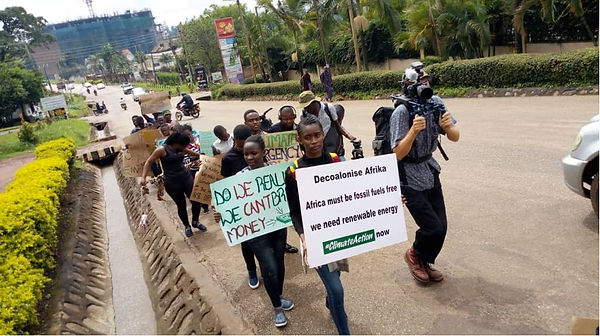
Environmental Activists, Uganda
Photo credit: FFF Uganda
Not only are the complexities of environmental and climate issues different, the forms of activism and experiences of activists are also diverse. There are three main Factors in which in the environmental movement in the GS is different compared to the GN:
-
Different levels of urgency of activism due to greater levels of environmental destruction. As mentioned previously, countries of the GS are often the first to feel the negative impacts of climate change. Furthermore, these countries suffer from environmental damages caused by logging, mining and other industries.
-
Forms of protest. The Global North has seen a lot of activism in the form of school strikes, which is a less suited action in countries, such as Sudan for example, where not every child has the privilege to go to school. In many countries of the GS, environmental activism centers mainly around policy, advocacy, campaigning, education and community work. [5]
-
Different dangers of activism. While activists in the GN face almost no real dangers, the same cannot be said for the GS. Every year, the Global Witness publishes a report on all killings of environmental activists around the world. Almost all countries listed are countries of the “Global South”. [6] Even if activists aren’t facing mortal danger, they are often met with police brutality and arrests by oppressive governmental systems. A recent example is the arrest of Indian climate activist Risha Davi. [7]

Fridays for Future India, among them Risha Davi, climate activists who was imprisoned in February 2021
Photo credit FFF Delhi

Interviews
In order to dive deeper into the subject we reached out to activists from countries of the “Global South” who were kind enough to share with us their experiences. We had the pleasure to talk to Laksh Sharma, coordinator of Fridays for Future Delhi, Nirere Sadrach, coordinator of Fridays for Future Uganda, Adong Cicilly, climate Activist for Fridays for Future International, and Gideon Commey, founder of the Ghana Youth Environmental movement.
You can find interviews we conducted with them along with further information on their work as well as links to their foundations on this website below. Future interviews will be published here as well.
Nirere Sadrach
coordinator of Fridays for Future Uganda

Nirere Sadrach is the founder of the End Plastic Pollution initiative, one of the coordinators for Fridays for Future Uganda and a Green Campaigner at Green Climate Campaign Africa.
He also is the founder of the Climate Watch Series - a blog and digital platform dedicated to creating awareness about environmental and climate issues.


Laksh Sharma
coordinator of FFF Delhi
Laksh is an activist and one of the local coordinators for Fridays for Future Delhi.
Due to the current situation and the danger that young environmental activists in India, in particular FFF, are facing at the moment, we went back and forth if we should publish this interview. In the end, together with Laksh, we came to the conclusion that it was important to share all this important information as widely as possible.

Photo Credit: Laksh Sharma | FFF Delhi
Find out more about Farmer’s protests in India going on at the moment.
Find out more about the imprisonment of 22 year-old climate Activist Disha Ravi
Sign the petition to free Disha Ravi!
Gideon Commey
author and founder of the Ghana Youth Environmental Movement


Gideon is the founder of the Ghana Youth Environmental movement and has over 15 years of experience working in the fields of climate change, and renewable energy as a public policy advocate. In 2016, in recognition of his environmental work, he was named one of the Top 30 Young Achievers in Ghana.
As a Climate Reality Leader he has been trained personally by global Climate Leader and Former U.S. Vice President Al Gore. Besides that he is a former Regional Youth Coordinator of the Royal Commonwealth Society.
He is also the author of the book “Making A Change:
A Comprehensive Guide for Leaders”
If you want to learn more about Gideon's work, you can also check out this article.
Or check out the following links:


GET THE BOOK
Adong Cicilly
Climate Activist for Fridays for Future International
„Action is my thing.. I don’t like just talking“
Adong Cicilly is an environmental scientist, climate activist and speaker. She was born and raised in Sudan and did part of her education in Uganda. Today, she works as an activist for Fridays for Future international, organizing and implementing climate protests and campaigns. Besides that, she works as an environmental specialist and marketer in graphic design.
„Hear us, talk to us, speak to us, help us out and share something - we might also help (you) out - work for the environment and keep pushing, never stop because this is something that is serious and we’re running out of time.“
